
Conduit End Fittings for Push-Pull and Bowden Cable Assemblies
Threaded and non-threaded conduit fittings used in our custom push-pull and Bowden cable assemblies.
Conduit Ends, Ferrules & Anchors
Tyler Madison stocks threaded conduit end fittings for .218 in and .307 in Bowden conduit in zinc-plated steel and stainless steel. Fittings are swaged to the conduit in house as part of a finished push-pull, Bowden, or throttle control assembly. Custom, non-standard conduit fittings can also be produced to print, including custom thread sizes, thread lengths, overall lengths, and conduit diameters.
Conduit End Fitting Applications
Conduit end fittings are used wherever a control cable is anchored at a fixed point and actuated from a distance.
- Push/Pull Controls
- Bowden Cables
- Throttle Cables
- Choke Cables
- Engine Stop Cables
- Clutch Cables
- Shift Cables
- Release Cables
- Latch Cables
- Steering Controls
- Brake Cables
- Valve & Damper Controls
- Lawn & Garden Equipment
- Exercise Equipment
- Seat & Window Components
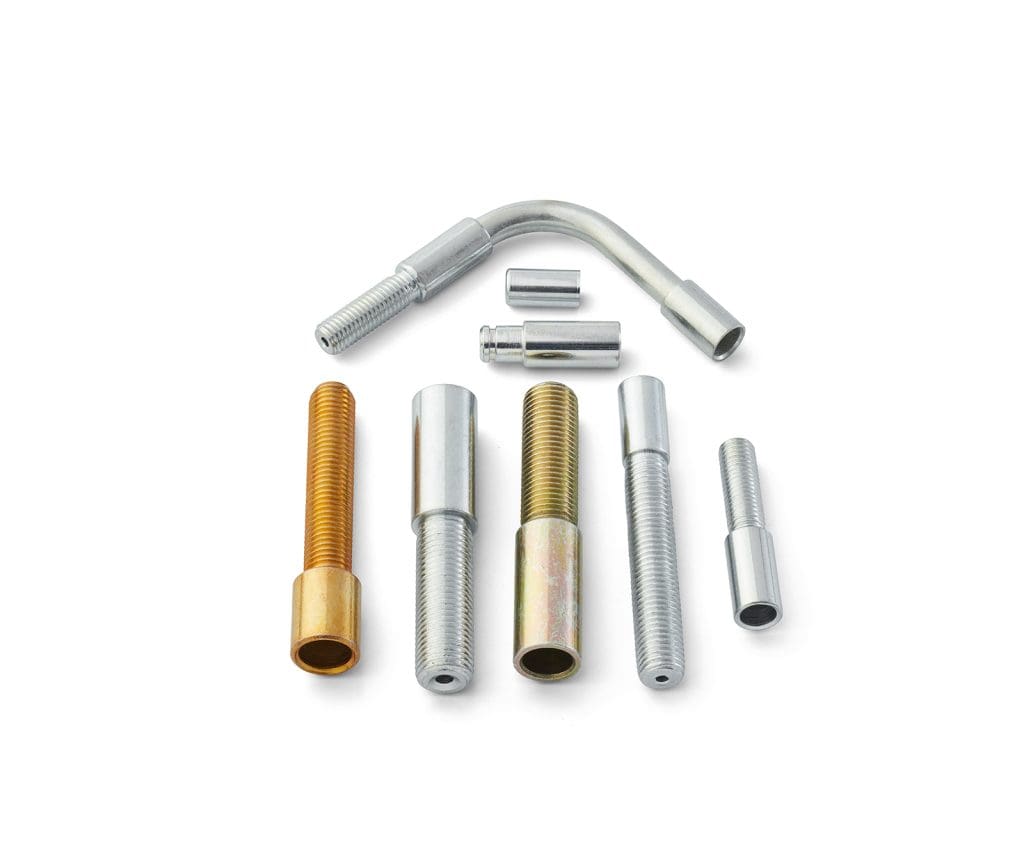
Threaded Conduit End Fittings
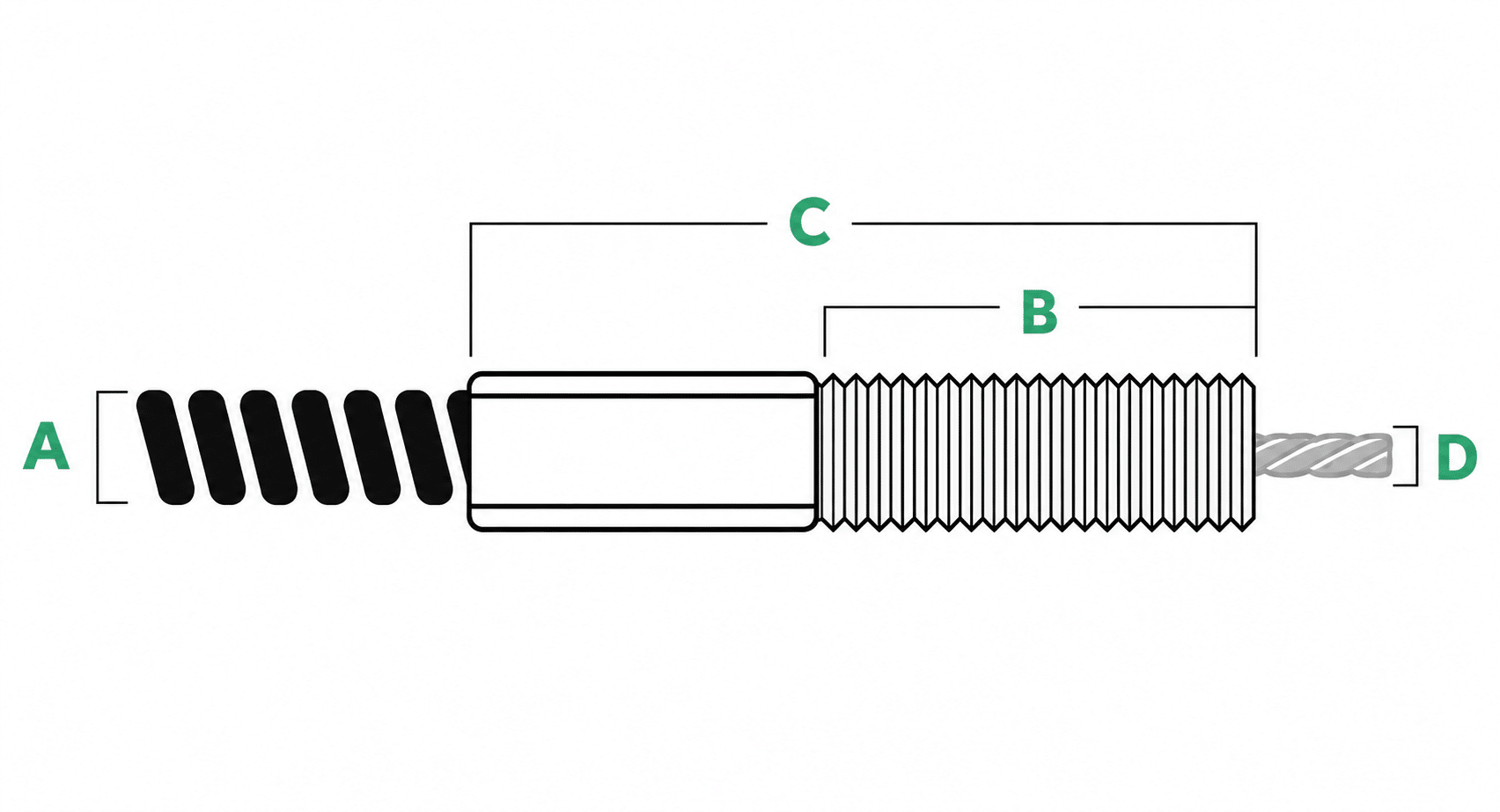
Threaded Conduit End Fitting Dimensions
| Part # | Bowden Conduit Diameter (w coating) A | Thread Size | Thread Size Length B (in) | Thread Size Length C (in) | Inner Wire Size D (in) | Material |
|---|---|---|---|---|---|---|
| 430-000 | .218 in | 1/4-28 | 3/4 | 1-3/8 | 3/64-1/16 | Zinc Plated |
| 444-002 | .218 in | 5/16-24 | 1.65 | 2-1/4 | 3/64-1/16 | Zinc Plated |
| 454-001 | .218 in | 5/16-24 | 1.62 | 2-1/4 | 3/64-1/16 | Stainless Steel |
| 444-003.5 | .307 in | 5/16-24 | 1.56 | 2-1/8 | 3/32 | Zinc Plated |
| 444-004 | .307 in | 3/8-24 | 1.145 | 2-1/8 | 3/32 | Zinc Plated |
Threaded conduit fittings are also called adjusters, bulkhead fittings, bulkhead terminals, conduit caps, and conduit end caps.
The .218 in fittings match 3/16 in lined Bowden conduit, and the .307 in fittings match 9/32 in lined Bowden conduit. Full conduit sizes, liners, and covers can be found on the conduit cable page.
Non-Threaded Conduit End Fittings
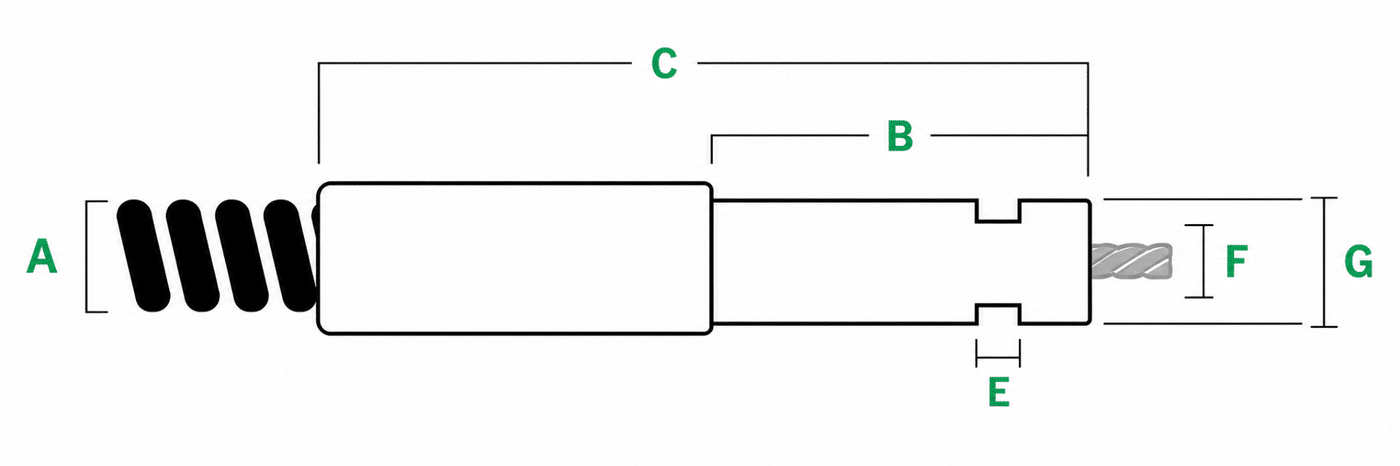
Snap Ring Conduit Fitting
| Part # | Bowden Conduit Diameter (with coating) A | Nose Length B | Overall Length C | Inner Wire Size D | Snap Ring Recess Width E | Snap Ring Recess Diameter F | End Diameter G | Material |
|---|---|---|---|---|---|---|---|---|
| 401-500 | .218 in | .290 in | .945 in | 3/64–1/16 in | .040 in | .208–.212 in | .242–.247 in | Zinc Plated Steel |
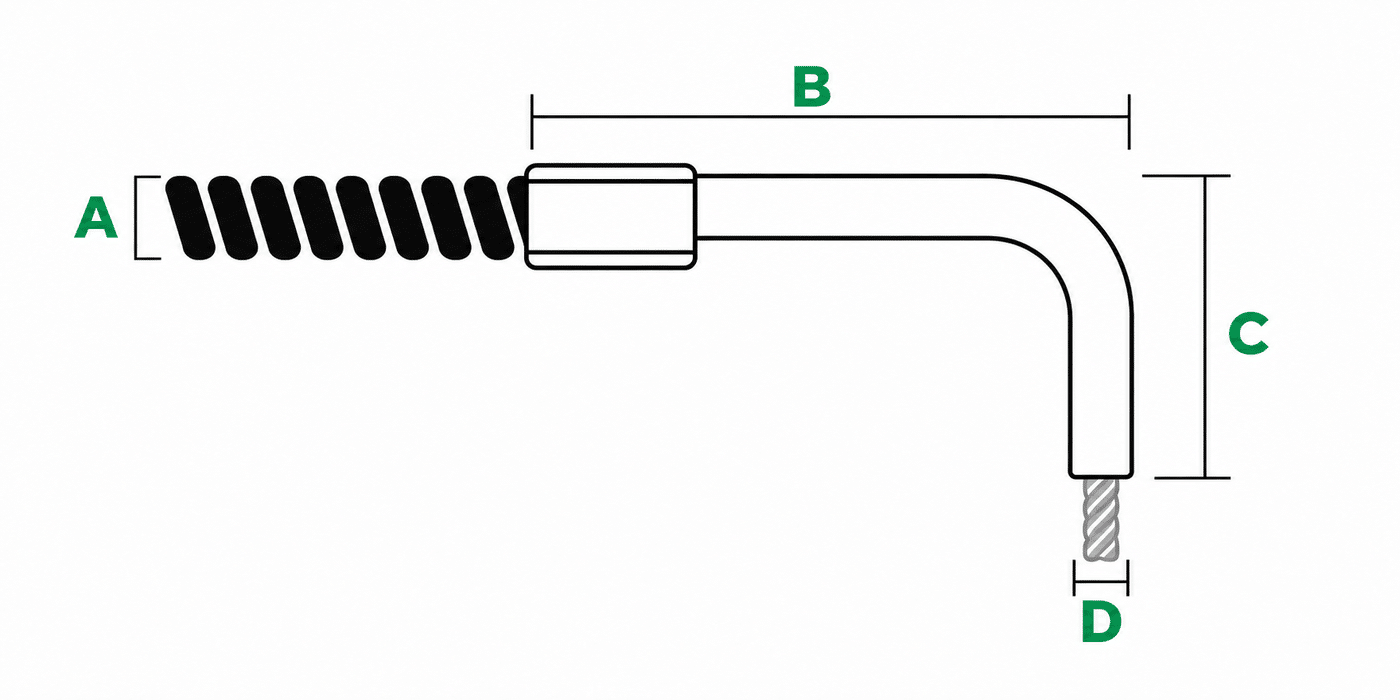
90 Degree Bend
| Part # | Bowden Conduit Diameter (with coating) A | Straight Length B | Bend Length C | Inner Wire Size D | Material |
|---|---|---|---|---|---|
| 444-015 | .218 in | 1.89 in | 1.125 in | 3/64–1/16 in | Zinc Plated |
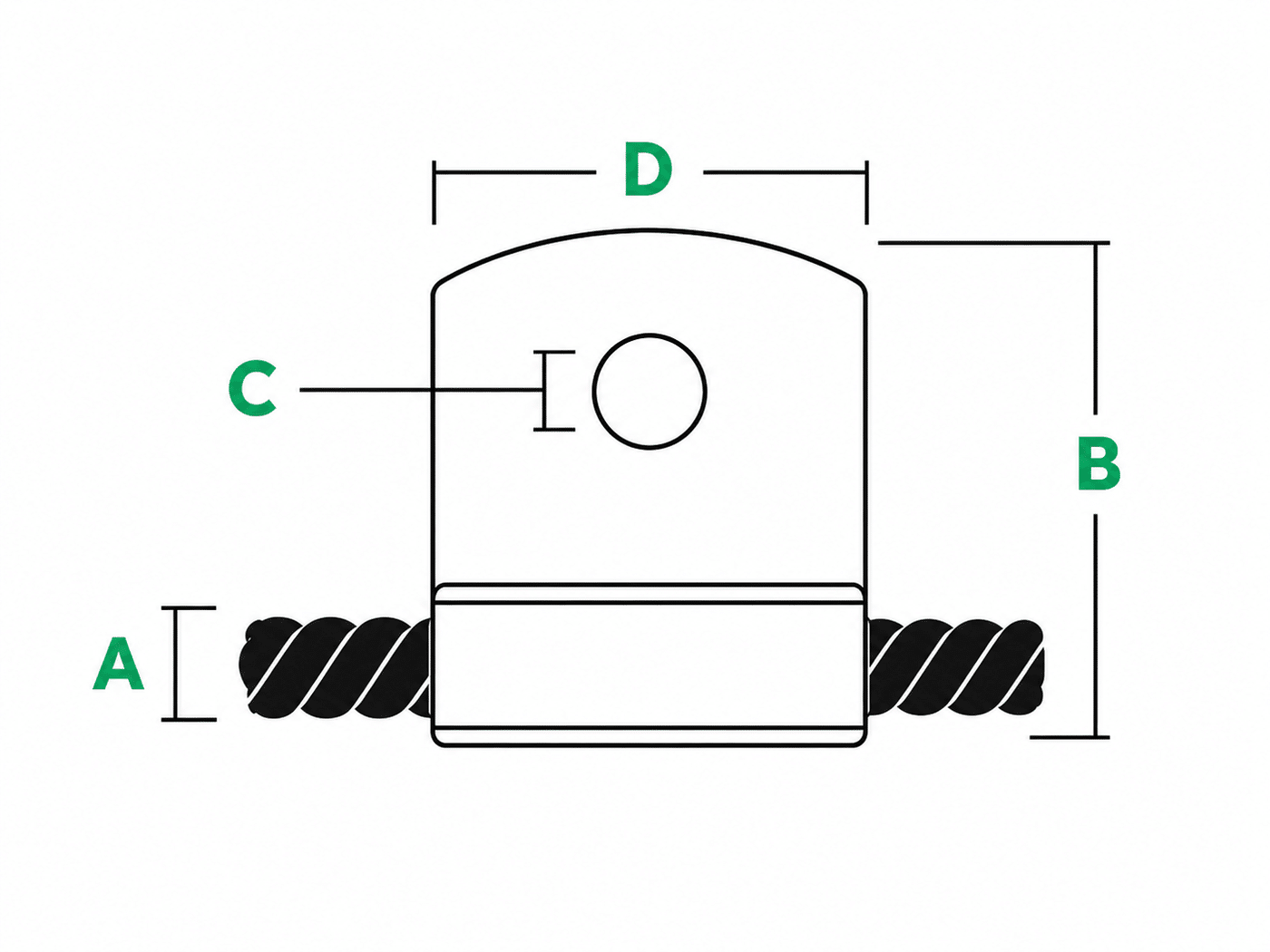
Conduit Clip
| Part # | Bowden Conduit Diameter (with coating) A | Overall Height B | Hole Diameter C | Clip Width D | Material |
|---|---|---|---|---|---|
| 444-016 | .218 in | 1.20 in | .405 in | .751 in | Zinc Plated |
| 444-017 | .218 in | 1.29 in | .405 in | .750 in | Rubberized Zinc Plate |
| 444-014 | .218 in | .940 in | .280 in | .500 in | Zinc Plated |
| 444-018 | .218 in | .830 in | .280 in | .505 in | Stainless Steel |
How Conduit End Fittings Work
Every push-pull and Bowden cable assembly is terminated twice at each end. The bare inner wire gets a terminal that moves with it and carries the load. The outer conduit gets a conduit end fitting that stays put, threaded into a bracket, panel, or housing so the conduit holds position while the inner wire slides through it.
A conduit end fitting terminates the outer conduit of a control cable assembly. It swages onto the conduit and threads into a bracket, panel, or housing, holding the conduit stationary while the bare inner wire slides through it. Conduit end fittings are not the same hardware as wire rope end fittings, which terminate the inner wire. A complete assembly uses both.
NOTE: The inner wire inside conduit is always bare. Coated cable creates friction against the conduit wall, which raises operating effort and shortens the life of the assembly. Where conduit diameters below are given as coated dimensions, that coating is on the outside of the conduit, never on the wire running through it.
How a Conduit Assembly Is Dimensioned
This is the step most often missed when someone specifies a control cable for the first time, and it is worth getting right before choosing a part number.
A conduit assembly has two lengths, not one. The conduit is measured between the two conduit end fitting reference points, one at each end. The inner wire is measured between its own two fitting reference points. The inner wire is deliberately longer, and that difference is the travel — how far it moves between fully retracted and fully extended.
A drawing that gives a single overall length has not specified the assembly. It is the most common reason a quote comes back with questions instead of a price.
Why fitting position matters
Because the conduit end fittings establish those reference points, where they sit determines the effective conduit length, and the effective conduit length determines how much of the inner wire’s travel reaches the driven end. Move a fitting and you have changed the travel. That makes fitting position a dimension on the print rather than an assembly detail to be worked out later.
Travel measured at the output is also always a little less than the travel designed in. Bends in the routing, the clearance between conduit and inner wire, and load on the system each absorb a small amount of motion, and more bends and heavier loads absorb more. Assemblies are normally built with a margin of extra travel to cover it.
Choosing a Conduit End Fitting
Start with the coated outside diameter of your conduit. That single measurement narrows the table to one group and settles the inner wire question at the same time: .218 in conduit carries a 3/64 in to 1/16 in wire, and .307 in conduit carries a 3/32 in wire.
Thread size comes next. It is set by the tapped hole or drilled panel in your bracket rather than by anything about the cable.
Material comes last. Zinc-plated steel is the standard and suits most enclosed and indoor equipment; stainless is the answer for washdown, marine, outdoor, and chemical exposure.
Fit matters in both directions. A fitting undersized for the conduit will not swage securely. An oversized one lets the conduit shift under load, which shows up at the control as lost motion. Because a conduit fitting carries compression rather than tension, it does not fail by pulling apart, it fails by losing position, and the assembly gets vague long before anything breaks. That is why the selection is worth more attention than it tends to get on a print.
What We Need to Quote a Conduit Assembly
Six things define the assembly:
- Coated Coated outside diameter of the Bowden conduit
- Mounting condition at each end: tapped hole, drilled panel, slotted bracket, or clamp
- Thread size, where the mount is threaded
- Bare inner wire diameter and construction
- Required travel at the driven end
- Operating environment
A print or a sketch covers anything not on that list. If you have an existing assembly you are replacing, photographs of both ends and an overall length will usually get us there. Have questions? Give us a call or build your assembly with our configurator.
All orders carry a $200.00 minimum. Standard lead time is approximately two weeks.
Conduit End Fittings vs. Wire Rope End Fittings
These often get confused, and specifying one when you meant the other is the most common mix-up on a control cable drawing. The difference comes down to which part of the assembly each one grips and whether it moves.
Conduit End Fittings
On this page- Terminate the outer conduit, or sheath
- Stay fixed to the bracket, panel, or housing
- React the compression the conduit carries
- Thread into a tapped hole, or seat in a slot or clamp
- Adjusters, bulkhead fittings, conduit caps, ferrules, grooved and clamp terminals
- When they fail, the control loses position and goes vague
Wire Rope End Fittings
Different page- Terminate the bare inner wire
- Move with the inner wire as it slides through the conduit
- Transmit the push or pull load to the driven component
- Swaged, crimped, or mechanically attached
- Ball ends, ball shanks, threaded studs, stamped eyes, forks, swivels
- See standard end fittings & terminals →

Conduit End Fittings FAQs
What is a conduit end fitting?
A conduit end fitting terminates the outer conduit of a control cable assembly and anchors it to a bracket, panel, or housing. It holds the conduit stationary so the bare inner wire can slide freely through it and transmit push-pull motion.
What is the difference between a conduit end fitting and a wire rope end fitting?
A conduit end fitting terminates the outer conduit and stays fixed to the structure. A wire rope end fitting terminates the inner wire, moves with it, and carries the load. A complete push-pull or Bowden assembly uses both.
What thread sizes are available on conduit end fittings?
Stock threaded conduit end fittings are available in 1/4-28, 5/16-24, and 3/8-24. The 1/4-28 and 5/16-24 sizes fit .218 in Bowden conduit, and the 5/16-24 and 3/8-24 sizes fit .307 in Bowden conduit. Custom thread sizes are produced to print.
What inner wire size fits through a conduit end fitting?
Fittings for .218 in Bowden conduit accept a 3/64 in to 1/16 in bare inner wire. Fittings for .307 in Bowden conduit accept a 3/32 in bare inner wire. The conduit diameter determines the compatible inner wire range.
How is travel determined on a conduit assembly?
Travel is the difference between the inner wire length and the conduit length, each measured between its own fitting reference points. The conduit end fittings set those reference points, so where they sit on the assembly determines how much travel reaches the driven end.
Can coated cable be used as the inner wire inside conduit?
No. Only bare wire rope is used as the inner wire inside conduit. A polymer coating creates friction against the conduit wall, which increases operating effort and shortens the life of the control.
Are stainless steel conduit end fittings available?
Yes. Part 454-001 is a stainless steel fitting for .218 in Bowden conduit with a 5/16-24 thread. Zinc-plated steel is the standard finish across the remaining stock sizes, and stainless fittings in other configurations are produced on request.
Can Tyler Madison produce a custom conduit end fitting?
Yes. Custom thread sizes, thread lengths, overall lengths, conduit diameters, and materials are routine. Send a print or a sketch showing the mounting condition and conduit diameter for a quote.